



Traditions and Customs on the Island of the Winds
Mykonos, globally renowned for its cosmopolitan atmosphere and golden beaches, reveals a different, more authentic side during Easter. Easter in Mykonos is a unique experience that combines deep religious tradition with distinct Cycladic customs, creating a festive setting that captivates both locals and visitors.
Holy Week in Chora and the Villages
As Holy Week begins, Mykonos takes on a different rhythm. The churches, with their characteristic white domes and blue windows, prepare for the solemn services. Each neighborhood in Chora and every small village on the island has its own church, where locals gather to experience the Passion.
The housewives of Mykonos prepare their homes, whitewashing courtyards and ledges, creating that characteristic Cycladic white that reflects the sunlight. At the same time, they bake traditional tsoureki (sweet bread) and “lambropites,” special pies filled with fresh cheese and eggs, a local specialty of the island.
Unique Mykonian Customs
A distinctive Easter custom in Mykonos is the “Bálos,” which takes place on Good Friday. A wooden platform is set up in the square of Ano Mera, the island’s largest village. There, young people from the village reenact scenes from Christ’s Passion, creating living tableaux that move the spectators.
Another unique tradition is the “Burning of Judas,” which occurs on Holy Saturday after the Resurrection. Locals craft an effigy of Judas, which is carried to the Tria Pigadia square in Chora, where it is burned as a symbolic act of eliminating evil.
The Epitaph Procession Through Chora’s Narrow Streets
On Good Friday, the Epitaphios (the decorated bier of Christ) is carried through the picturesque alleys of Chora, creating a deeply moving experience. Decorated with flowers from the island’s gardens, the Epitaphios moves through narrow streets lined with whitewashed houses, while the faithful follow with lit
candles, forming a luminous procession that reflects off the white surfaces. A particularly touching moment occurs when the procession reaches the harbor, where the sea mirrors the glow of the candles, creating a mesmerizing spectacle.
The Resurrection and the Festive Meal
On Holy Saturday night, Mykonos’ churches fill with worshippers awaiting the Resurrection. The main ceremony takes place at Panagia Paraportiani, the island’s iconic church complex. When “Christos Anesti” (Christ is Risen) is proclaimed, the sky lights up with fireworks, and the bells ring joyously.
After the service, families return home for the traditional Resurrection dinner, featuring magiritsa (a lamb offal soup), red-dyed eggs, and lambropita. In Mykonos, magiritsa is made with local variations, often enriched with fresh herbs from the island’s gardens.
Easter Sunday: Celebration and Gastronomy
Easter Sunday is a day of joy and festivity across the island. Courtyards fill with families and friends roasting lamb on the spit while wine flows abundantly. In addition to the traditional lamb, Mykonos is known for “tsiladáki,” a local dish featuring kid goat wrapped in vine leaves and slow-cooked with special herbs.
In the square of Ano Mera, a grand feast takes place, featuring traditional dances and music. Locals dressed in traditional attire dance the “Bálos” and other folk dances, inviting visitors to join the celebration.
Easter in Mykonos: An Authentic Experience
What makes Easter in Mykonos truly special is the contrast between the island’s cosmopolitan image and the authenticity of its celebrations. Visitors have the chance to see a different side of Mykonos—an island deeply connected to its traditions, where locals faithfully preserve the customs of their ancestors.
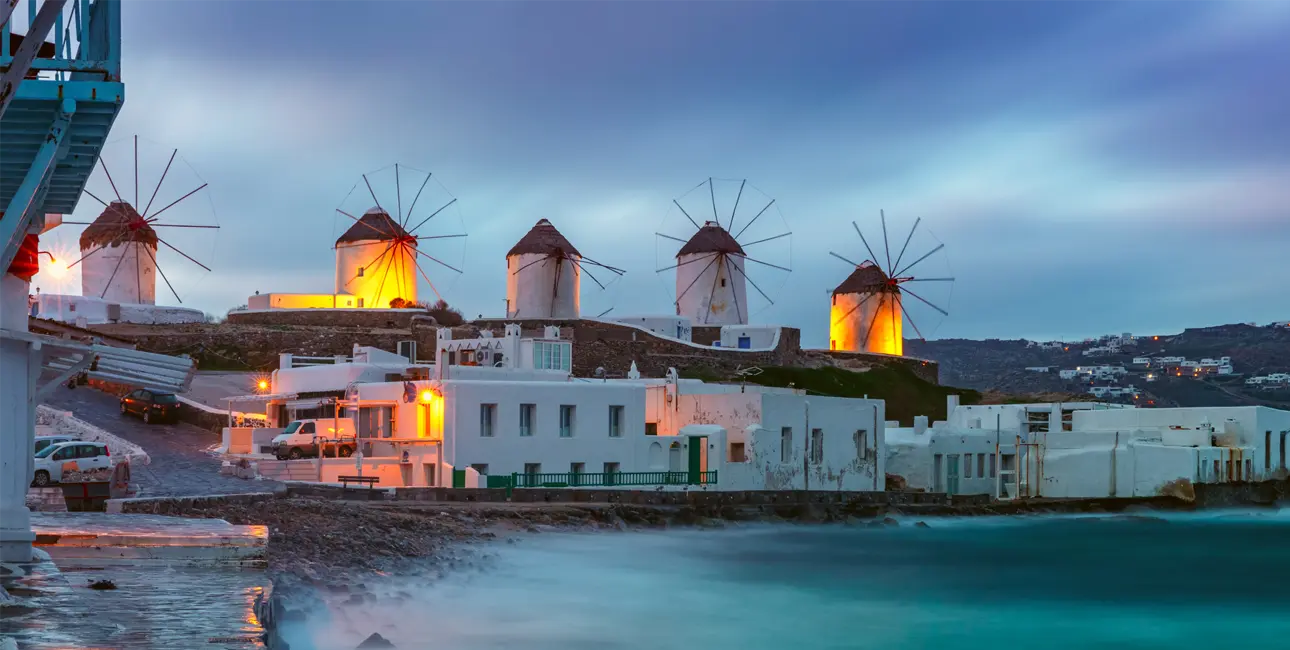
Moreover, spring is the perfect time to visit Mykonos, as nature is in full bloom, with hills covered in wildflowers and a climate ideal for exploration. Visitors can combine participation in the religious events with sightseeing around the island, such as the famous windmills of Chora, the Monastery of Panagia Tourliani, and the stunning beaches that remain peaceful and serene at this time of year.
Easter in Mykonos offers a true Cycladic experience—one of tradition, spirituality, and hospitality—revealing the island’s authentic soul beyond the lights and glamour of summer.
Leave a Reply